
Tag Archive for: Container

CTU Code > Levodry

⏱ Reading time: 4 minutes

CTU Code and Levodry Gel: compliant desiccant bags for container protection

Yes, Levosil’s Levodry Gel complies with the CTU Code recommendations on humidity control inside containers. The calcium-chloride-based desiccant bags of the Levodry Gel range keep the internal relative humidity of the container below the 60% safety threshold, in line with Annex 3 of the CTU Code for reaching the “container-dry” state.

What the CTU Code is

The CTU Code (Code of Practice for the Packing of Cargo Transport Units) is the code of practice jointly published by IMO (International Maritime Organization), ILO (International Labour Organization) and UNECE (United Nations Economic Commission for Europe). It was endorsed in 2014, as an update of the previous 1997 Guidelines.

The supporting informative material is published as IMO circular MSC.1/Circ.1498.

The CTU Code is not a mandatory regulation: it is a set of global recommendations, adopted as an international reference by freight forwarders, insurance companies, customs authorities and used in many countries as a basis for national legislation on cargo transport in containers.

It covers all transport modes of cargo transport units: maritime, road and rail.

What the CTU Code says about humidity in containers

Humidity control is addressed in Annex 3 of the CTU Code and further discussed in the informative material MSC.1/Circ.1498.

The key points are:

  • the cargo should be brought to the “container-dry” state before stowing, meaning a moisture content that does not release harmful amounts of water vapour during transport;
  • when pre-drying of the cargo is not sufficient, the use of desiccant bags is recommended to absorb the excess moisture;
  • risk thresholds are defined for the internal relative humidity (RH) of the container.

Relative humidity thresholds indicated by the CTU Code

Relative humidityRisk
≥ 40%Corrosion of ferrous metals
≥ 75%Mould growth on wood, food, textiles and hygroscopic goods
< 60%Level considered safe, with a margin against temperature variations

The RH below 60% value is indicated as the reference condition to prevent condensation (the so-called “container rain”) even in the presence of strong day/night temperature swings during maritime transport.

What container rain is and why it matters

Container rain is the phenomenon where the water vapour in the internal air of the container condenses on the walls and ceiling during nighttime cooling, then drips back on the cargo as actual rainfall. Consequences include:

  • corrosion of metal parts;
  • mould and fungal growth;
  • collapse of cardboard packaging;
  • stains, halos and packaging discolouration;
  • deterioration of hygroscopic products (coffee, cocoa, textiles, wood, dry food).

Even a few condensation cycles can cause irreversible damage.

How Levodry Gel ensures compliance with the CTU Code

Levodry Gel is a container-specific desiccant bag formulated with a mixture of calcium chloride and a gelling agent. Its technical features make it fully compliant with the CTU Code recommendations:

  • Absorption capacity up to 300% of its own weight: it captures the water vapour released by the cargo and packaging materials throughout the entire maritime transport.
  • Keeps the internal RH below 60%: it operates in the 40%–60% relative humidity window, exactly the range indicated by the CTU Code as safe.
  • Moisture-to-gel transformation: the gelling agent locks in the absorbed water, preventing any liquid from leaking out of the bag and contaminating the cargo.
  • Flexible formats: available in blankets, hook chains and single bags with PE side, suitable for standard dry containers, reefer containers and different loading configurations.
  • Regulatory safety: REACH-registered (Regulation EC 1907/2006), notified under EU Regulation 2017/542 (UFI) via the ECHA PCN portal and the Italian ISS, DMF-free according to Decision 2009/251/EC, free from SVHC substances.
  • Food-contact safe: suitable for the protection of food shipments and raw materials intended for human consumption.
  • FCC Guidelines compliant for the shipment of cocoa beans in containers.

How to size Levodry Gel correctly for a container

Sizing of Levodry Gel for a container is not covered by any standard: the correct quantity is determined by Levosil based on the technical experience gained since 1964 and on tests carried out in the internal climate chamber, considering several factors:

  • internal container volume (20′, 40′, 40′ HC);
  • voyage duration and route;
  • cargo type (hygroscopic or non-hygroscopic);
  • presence of wooden pallets and other materials releasing moisture;
  • possible use of plastic barrier covers or VCI films on the cargo.

Levosil provides direct technical support to recommend the optimal quantity on a case-by-case basis.

Further reading

For further information on the regulatory compliance of Levodry Gel:

The UFI code of Levodry Gel is notified via the ECHA PCN portal and the Italian ISS, and is available on request for B2B use.

Contact

You can contact us now for more information: 0039 011 96 43 430 — info@levosil.com
UFI mandatory on labels: Levodry Gel is already compliant

What the UFI is and what it does

The UFI (Unique Formula Identifier) is a unique alphanumeric code, made up of 16 characters, that must be printed on the product and on its label. Its purpose relates to health and safety: it unequivocally links information on the composition of a mixture to a specific product placed on the market. In the event of accidental exposure, it allows poison centres to quickly retrieve information on the composition and toxicology of the mixture by consulting the European database that associates each UFI code with the information notified through ECHA.

Who keeps the UFI database?

The UFI does not exist on its own: it is linked to a PCN notification (Poison Centre Notification). ECHA provides a centralised portal (the ECHA submission portal) for notification to poison centres. In Italy, the Istituto Superiore di Sanità (ISS) is the body designated to receive the information — including the chemical composition — relating to mixtures classified as hazardous. This information makes up the Archive of Hazardous Preparations (Archivio dei Preparati Pericolosi, APP), which poison centres can consult in an emergency.

The UFI refers to a single product and is “personal”

Every UFI code is personal and non-transferable: because it is built from the VAT number of the company placing the product on the market and from a specific formulation number, it unequivocally links a given mixture to the party responsible for it. Products with a different composition have different UFIs, and every change in the formula corresponds to a new code. It should be stressed, however, that the code cannot be used to trace the composition of the mixture or any other confidential data: the UFI is not decodable, and the information associated with it is held in a database accessible exclusively to poison centres and healthcare facilities, in the event of an emergency. For this reason, its presence on the label in no way exposes resellers or those who market the product; it represents solely a guarantee of safety and compliance.

Reference legislation and obligations for those placing the product on the market

The UFI originates from Regulation (EU) 542/2017, which was incorporated into Annex VIII of the CLP Regulation 1272/2008. It is not an option but a legal obligation: companies that place hazardous mixtures on the market must transmit the necessary information to the competent national bodies, so that poison centres can rapidly provide medical advice in an emergency. The parties subject to the obligation are importers and downstream users who, in the course of industrial and professional activities, place on the market mixtures that are hazardous to health and/or present physical hazards. Failure to comply with the obligation may result in products being withdrawn from the market and in financial penalties, with possible inspections by the competent authorities.

Since when it has been mandatory to display it on the product

The final deadline has now passed: since 1 January 2025, the UFI on the label has been mandatory for all hazardous mixtures marketed within the European Economic Area, without exception. The obligation also applies to mixtures already placed on the market before that date.

The case of calcium chloride desiccants

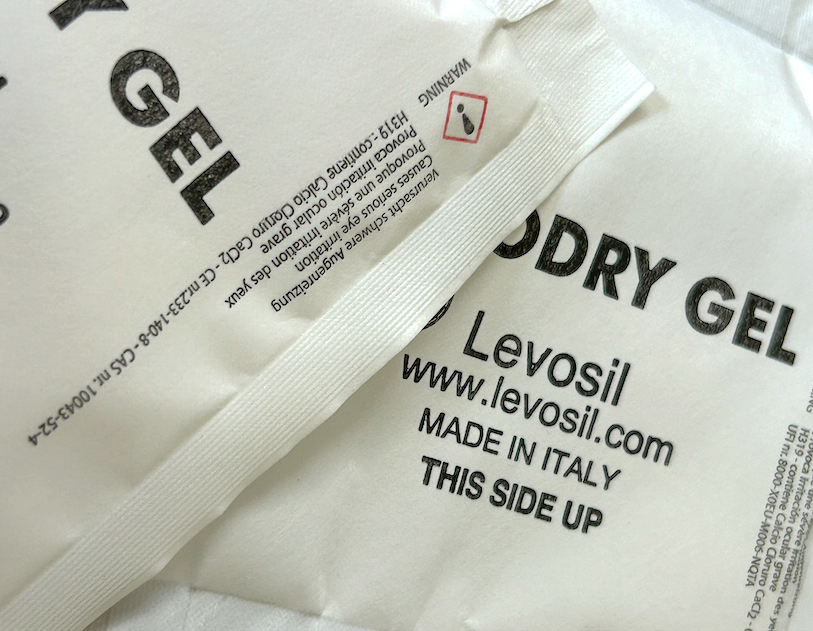
The classification of calcium chloride — the main component of all desiccants used to protect containers, Levodry Gel included — is the reason why the irritant symbol and the information required by law are printed on the label and on the product itself. Under normal conditions of use, no contact is expected between the person using the desiccant bag and the calcium chloride contained inside it; this does not, however, relieve the manufacturer and the party placing the product on the market of the obligation to indicate the presence of a potentially irritant substance inside the packaging.

Desiccant bags based on calcium chloride, such as Levodry Gel — which contains between 60% and 90% of it — are classified as irritant (eye irritation category 2, H319 – “Causes serious eye irritation”) under the CLP Regulation. They therefore fall fully within the scope of the mixtures subject to the obligation. For this reason they must be notified through ECHA’s PCN portal and, for Italy, registered with the Istituto Superiore di Sanità (ISS). Only after this registration is the UFI code generated, validated and affixed to the product. Once these formalities have been completed, the product can be placed on the market.

It is important to note that a product requiring any hazard classification cannot be placed on the market unless the UFI code has been registered.

Product safety

It is essential to understand that, in the case of Levodry Gel, the calcium chloride is contained within a functional barrier, and therefore in normal working operations the user is not expected to come into direct contact with the calcium chloride. Nevertheless, the law requires that the product be labelled and that the UFI code be registered with the competent authority as a precaution, in case of improper use or of leakage of the calcium chloride should the outer casing break.

Where the code must appear: label and product

The UFI must be physically present on the product and on its label, printed or affixed in a visible, legible and indelible manner, preceded by the letters “UFI”, which are not to be translated into the various languages.

Levosil has already done everything

Levodry Gel has its own code duly stated in the Safety Data Sheet and affixed to the product label, in full compliance with the CLP Regulation and its Annex VIII. Notification to the poison centres has been carried out, and the emergency contact details are indicated in every language version of the sheet. Choosing Levosil means purchasing products that are already compliant, with no risk of non-conformity for those who resell them or place them on the European market in turn.

Dehydrating Bags – “Salts”

Dehydrating bags (commonly also referred to as “salts”) are used to remove moisture from within a package to preserve the quality of the products inside.

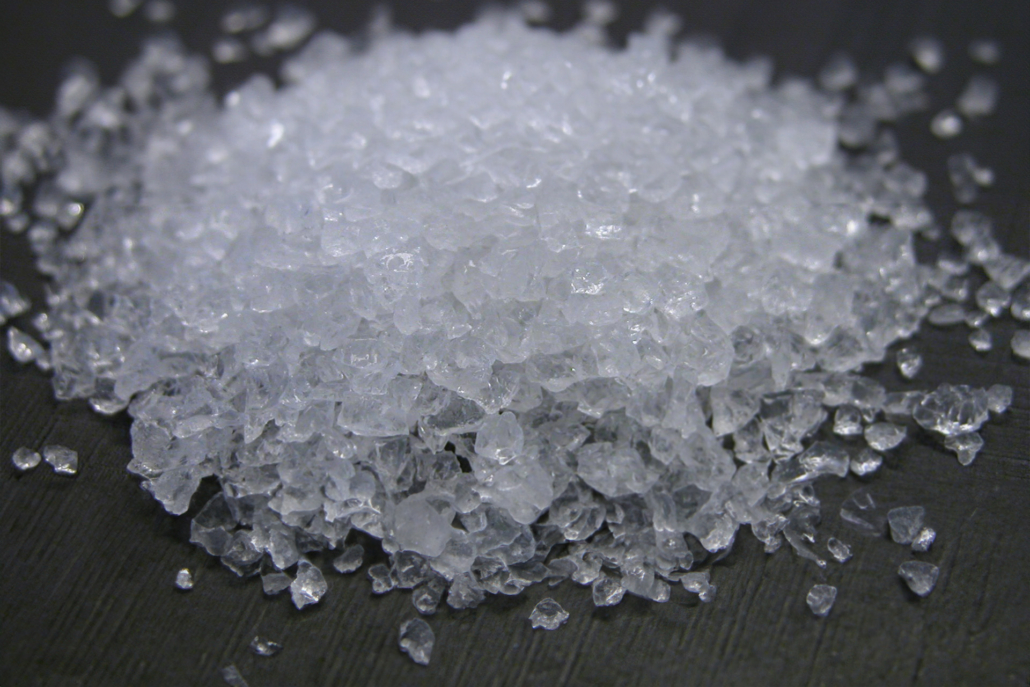
Although often called “dehydrating salts,” none of the desiccants used for packaging protection are actually salts. In fact, the DIN 55473 industry standard specifies that dehydrating bags must not contain any trace of salt (chlorides) to prevent oxidation when in direct contact with metal surfaces. Over the years, desiccants have been likened to salt, likely because silica gel resembles coarse kitchen salt and because salt itself has hygroscopic properties. However, salt is not technically a dehydrating agent, as it adsorbs moisture but does not retain it as effectively as clay or silica gel.

Why Are Salts Not Used in Packaging?

Firstly, dehydrating bags are placed inside packaging in direct contact with goods that need protection, so they must not cause any type of oxidation.

Secondly, silica gel and dehydrating clay have characteristics that common salts do not possess.

Desiccants Are Highly Efficient Materials:

  • They can reduce relative humidity to levels below 4%.
  • They do not easily release adsorbed moisture.

The primary desiccants used for packaging protection are:

  • Calcium Bentonie (also known as Montmorillonite, Salt, Expanded Clay, Active Clay, Desiccant, Bentonite, Dried Clay)
  • Silica Gel (often also called Salt, Silica Gel, Silica, Silicon, Drying Gel)

Are Salts Used in Protective Packaging?

The distinction between desiccants (silica gel and clay) and salts is important to avoid misunderstandings in certain situations.

Calcium chloride (which is indeed a salt) finds its natural application in dehydrating bags used to protect containers from the “rain effect.”

In this context, it’s necessary to absorb large amounts of moisture without needing to reach low relative humidity levels (typically aiming to maintain relative humidity around 50% within the container). Thus, the characteristics of calcium chloride make it the ideal desiccant for this purpose.

It is a hygroscopic salt characterized by a high capacity (the amount of water vapor it can remove from the environment) and limited efficiency (the dryness level it creates around itself is about 40% relative humidity).

Desiccant Selection

Protection within packaging

  • Dehydrating Clay: General industrial use.
  • Silica Gel: Pharmaceutical industry.

Transport Protection via Container

  • Calcium Chloride: Levodry Gel, Container Bag.