
CTU Code > Levodry
⏱ Reading time: 4 minutes
CTU Code and Levodry Gel: compliant desiccant bags for container protection
Yes, Levosil’s Levodry Gel complies with the CTU Code recommendations on humidity control inside containers. The calcium-chloride-based desiccant bags of the Levodry Gel range keep the internal relative humidity of the container below the 60% safety threshold, in line with Annex 3 of the CTU Code for reaching the “container-dry” state.
What the CTU Code is
The CTU Code (Code of Practice for the Packing of Cargo Transport Units) is the code of practice jointly published by IMO (International Maritime Organization), ILO (International Labour Organization) and UNECE (United Nations Economic Commission for Europe). It was endorsed in 2014, as an update of the previous 1997 Guidelines.
The supporting informative material is published as IMO circular MSC.1/Circ.1498.
The CTU Code is not a mandatory regulation: it is a set of global recommendations, adopted as an international reference by freight forwarders, insurance companies, customs authorities and used in many countries as a basis for national legislation on cargo transport in containers.
It covers all transport modes of cargo transport units: maritime, road and rail.
What the CTU Code says about humidity in containers
Humidity control is addressed in Annex 3 of the CTU Code and further discussed in the informative material MSC.1/Circ.1498.
The key points are:
- the cargo should be brought to the “container-dry” state before stowing, meaning a moisture content that does not release harmful amounts of water vapour during transport;
- when pre-drying of the cargo is not sufficient, the use of desiccant bags is recommended to absorb the excess moisture;
- risk thresholds are defined for the internal relative humidity (RH) of the container.
Relative humidity thresholds indicated by the CTU Code
| Relative humidity | Risk |
|---|---|
| ≥ 40% | Corrosion of ferrous metals |
| ≥ 75% | Mould growth on wood, food, textiles and hygroscopic goods |
| < 60% | Level considered safe, with a margin against temperature variations |
The RH below 60% value is indicated as the reference condition to prevent condensation (the so-called “container rain”) even in the presence of strong day/night temperature swings during maritime transport.
What container rain is and why it matters
Container rain is the phenomenon where the water vapour in the internal air of the container condenses on the walls and ceiling during nighttime cooling, then drips back on the cargo as actual rainfall. Consequences include:
- corrosion of metal parts;
- mould and fungal growth;
- collapse of cardboard packaging;
- stains, halos and packaging discolouration;
- deterioration of hygroscopic products (coffee, cocoa, textiles, wood, dry food).
Even a few condensation cycles can cause irreversible damage.
How Levodry Gel ensures compliance with the CTU Code
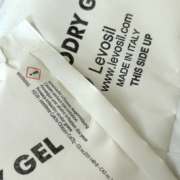
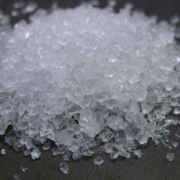
Levodry Gel is a container-specific desiccant bag formulated with a mixture of calcium chloride and a gelling agent. Its technical features make it fully compliant with the CTU Code recommendations:
- Absorption capacity up to 300% of its own weight: it captures the water vapour released by the cargo and packaging materials throughout the entire maritime transport.
- Keeps the internal RH below 60%: it operates in the 40%–60% relative humidity window, exactly the range indicated by the CTU Code as safe.
- Moisture-to-gel transformation: the gelling agent locks in the absorbed water, preventing any liquid from leaking out of the bag and contaminating the cargo.
- Flexible formats: available in blankets, hook chains and single bags with PE side, suitable for standard dry containers, reefer containers and different loading configurations.
- Regulatory safety: REACH-registered (Regulation EC 1907/2006), notified under EU Regulation 2017/542 (UFI) via the ECHA PCN portal and the Italian ISS, DMF-free according to Decision 2009/251/EC, free from SVHC substances.
- Food-contact safe: suitable for the protection of food shipments and raw materials intended for human consumption.
- FCC Guidelines compliant for the shipment of cocoa beans in containers.
How to size Levodry Gel correctly for a container
Sizing of Levodry Gel for a container is not covered by any standard: the correct quantity is determined by Levosil based on the technical experience gained since 1964 and on tests carried out in the internal climate chamber, considering several factors:
- internal container volume (20′, 40′, 40′ HC);
- voyage duration and route;
- cargo type (hygroscopic or non-hygroscopic);
- presence of wooden pallets and other materials releasing moisture;
- possible use of plastic barrier covers or VCI films on the cargo.
Levosil provides direct technical support to recommend the optimal quantity on a case-by-case basis.
Further reading
For further information on the regulatory compliance of Levodry Gel:
The UFI code of Levodry Gel is notified via the ECHA PCN portal and the Italian ISS, and is available on request for B2B use.
Contact
You can contact us now for more information: 0039 011 96 43 430 — info@levosil.com