
Molecular sieves: selective moisture adsorption
⏱ Reading time: 3 minutes
Molecular sieves: selective moisture adsorption and high-temperature resistance
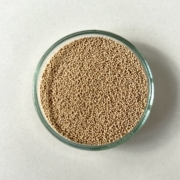
Molecular sieves are synthetic zeolites with calibrated porosity, used to produce desiccant bags for special applications where silica gel or activated clay are not suitable. Types 4A and 3A are the ones normally used for moisture adsorption.
Their use makes sense in two cases: when the environment contains other gases that must not be removed together with the moisture, and when moisture must be adsorbed and retained even at high temperatures. Outside these cases, silica gel or activated clay offer equivalent performance and are easier to handle.
Structure: why adsorption is selective
A molecular sieve is an aluminosilicate with a three-dimensional structure of channels and cavities of regular size. The pore opening determines which molecules can enter and be retained: 3A and 4A sieves adsorb only sufficiently small, polar molecules, such as water.
This regularity is the key difference from silica gel and activated clay, which are non-selective adsorbents: they retain moisture, but also other gases present in the air.
High-voltage switchgear
The application where selectivity is essential is high-voltage switchgear insulated with gas (arc-quenching gas). Here the goal is to remove residual moisture without removing the insulating gas: a non-selective desiccant would adsorb both, altering the composition of the gas and its function. Thanks to its calibrated pores, the molecular sieve solves this specific problem.
High-temperature performance
Unlike the other desiccants used in industrial packaging, molecular sieves adsorb and retain moisture even at high temperatures. Silica gel and activated clay begin to lose effectiveness at around 50 °C; the molecular sieve maintains good desiccant capacity even above 120 °C.
Its regeneration temperature exceeds 300 °C: even at very high temperatures, the material does not release the adsorbed moisture. For the same reason, under normal conditions a molecular sieve is practically impossible to regenerate.
Why they are not used for container protection
In shipping containers, the problem is absorbing large quantities of moisture at ambient temperature: neither selectivity nor heat resistance is needed. The right solution is calcium chloride (Levodry Gel).
Pharmaceutical applications
Molecular sieves are often used in the pharmaceutical sector, but in most cases they offer no real advantage over silica gel. The performance of molecular sieve and silica gel is practically identical (both materials have a desiccant capacity of 20% of their weight under standard test conditions of 40% relative humidity and 23 °C). A molecular sieve may be useful when moisture, but not other gases, must be removed inside the drug package, but these cases are very rare.
It is often pointed out, correctly, that molecular sieves adsorb moisture faster than other desiccants. Under normal conditions and in small packages, however, the difference is barely measurable.
In short
- Molecular sieve = synthetic zeolite (typically 3A or 4A) with calibrated porosity and selective moisture adsorption.
- Use it when moisture must be removed without capturing other gases, and when moisture must be retained at high temperatures (active at 120 °C, regeneration above 300 °C).
- Not needed in containers: the right solution is calcium chloride (Levodry Gel).
- In pharmaceutical applications, adsorption performance is comparable to silica gel; the speed advantage is marginal.
- Our technical team is available to recommend the most suitable desiccant for the result you need to achieve.
You can contact us now for more information: 0039 011 96 43 430 + info@levosil.com