Wood in containers: most of the moisture comes from the cargo, not the air
⏱ Reading time: 9 minutes
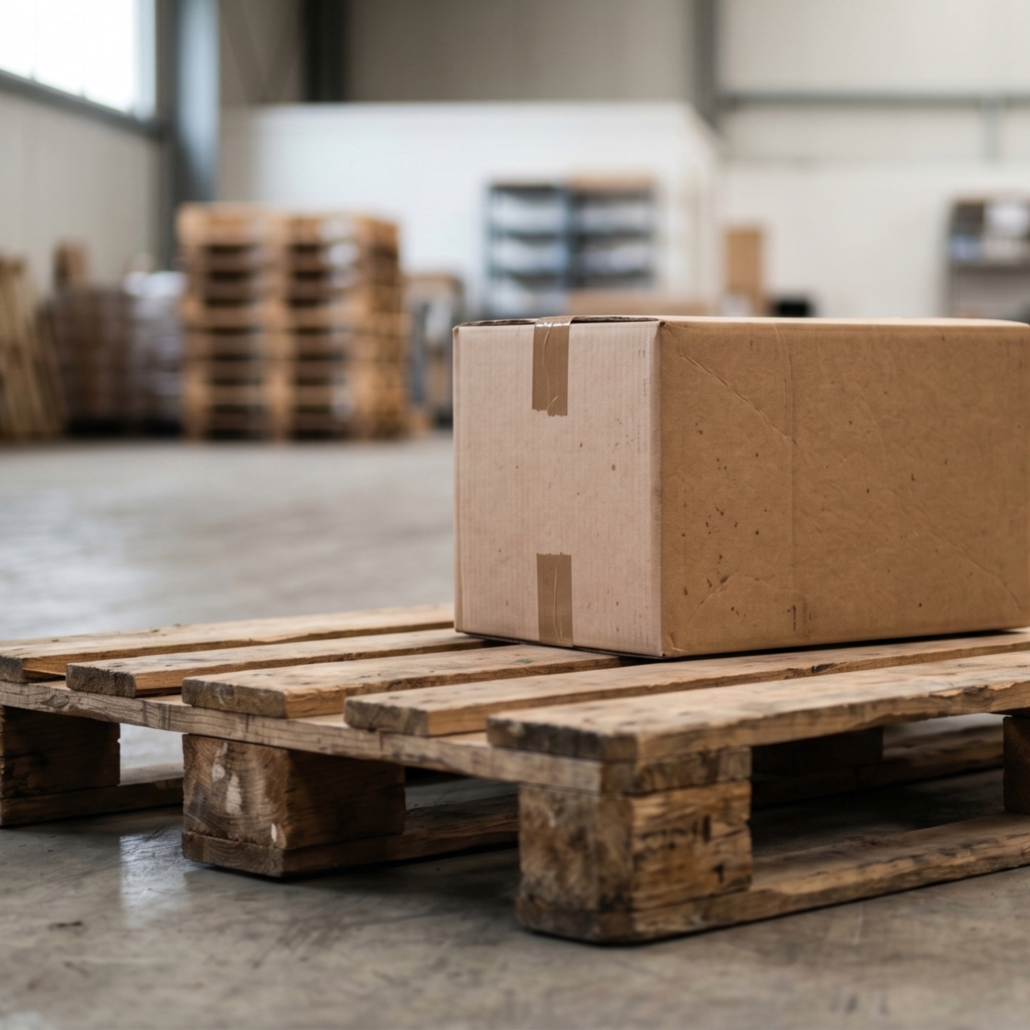
Wood moisture in a shipping container, together with the water held in cardboard and in the goods themselves, is by far the largest source of water on board. The air inside a 20′ container holds less than one kilogram of water vapour, while a single Euro pallet holds several kilograms and can release part of it during the voyage. This is why desiccant bags for containers should be sized on the cargo and its packaging, not only on the volume of air.
The air holds little water
It is often pointed out, correctly, that warm humid air trapped in the container at the port of loading brings water vapour with it. The amount, however, is small: at 30 °C and 90% relative humidity (RH) one cubic metre of air holds about 27 g of water, so the roughly 33 m³ of an empty 20′ container hold about 0.9 kg (about 1.8 kg in a 40′ container). Far more water is held in what is loaded: pallets, crates, cartons and the goods themselves.
Hygroscopic materials and desiccants
A material is hygroscopic when it absorbs and releases water vapour depending on the humidity and temperature of the surrounding air, until it reaches equilibrium (the equilibrium moisture content, meaning the amount of water the material holds steadily at a given temperature and relative humidity). In a closed container it is these materials that set the humidity of the air, not the other way round.
Desiccants are hygroscopic too: the difference lies in how strongly they hold on to the water.
- Wood, cardboard and natural fibres exchange moisture with the air continuously. When the temperature rises they release it easily, and when the air cools they take it back only slowly, which is why the vapour released in the meantime settles on the coldest surfaces.
- Desiccants capture moisture even when the air is relatively dry and bind it more strongly. They too can release part of it when the temperature rises, but only at higher temperatures and with more difficulty. In the calcium chloride of Levodry Gel, the water captured forms a solution that remains locked in the gel.
Hygroscopic materials in a container
- Wood: pallets, crates, cages, dunnage and bracing timber
- Corrugated board, paper and paperboard
- Textiles and natural fibres: cotton, wool, jute sacks
- Leather and hides
- Agricultural commodities: coffee, cocoa, grain, seeds, tobacco, spices
- Nylon (polyamide) and some other plastics
How much water the cargo holds
Wood moisture content is expressed as a percentage of the oven-dry mass of the wood: a Euro pallet of about 25 kg at 18% moisture consists of about 21.2 kg of dry wood and 3.8 kg of water. The comparison below is based only on this figure and on the equilibrium values given further on.
| Source of water | Water held | Water that can be released |
|---|---|---|
| Air in an empty 20′ container (30 °C, 90% RH) | about 0.9 kg | not applicable |
| One Euro pallet, wood at 18% | about 3.8 kg | about 1 kg, reaching equilibrium with air at 70% RH (13%) |
| Eleven Euro pallets (one tier in a 20′ container) | about 42 kg | about 11 kg |
| One pallet made of green (undried) wood | over 4.5 kg | most of it, as the wood is far from equilibrium |
| 10 kg of corrugated board (water content 8-14%) | up to 1.4 kg | about 0.6 kg, going from 14% to 8% |
Figures for green wood and corrugated board come respectively from the Center for Packaging and Unit Load Design at Virginia Tech and from the Transport Information Service (TIS) of the German insurers’ association GDV.
These are theoretical quantities: over a voyage of a few weeks, moisture is exchanged mainly by the surface layer of the wood, so the water actually released depends on the length of the voyage and on temperature swings. The comparison still shows where the excess water in a container comes from: even a single pallet holds more than the air around it.
When wood releases water
The release follows the day and night cycle. During the day the sun heats the steel shell and the air inside, whose relative humidity falls: wood and cardboard, now wetter than the air, give off vapour. At night the ceiling and walls cool first and drop below the dew point (the temperature at which water vapour starts to condense), so the vapour released during the day turns into droplets. Wood reabsorbs moisture from the air only slowly, and the cycle repeats with every temperature swing, particularly when passing between climate zones and during port stays.
Container rain
Condensation forming on the ceiling drips onto the cargo below: this is known as container rain. The droplets wet the top cartons, stain the packaging and create the conditions for mould, even when the container was perfectly dry at departure. The CTU Code, the IMO/ILO/UNECE code of practice for packing cargo transport units, calls for this risk to be taken into account.
Equilibrium moisture content of wood
The table shows the moisture content that wood reaches over time in contact with air at a given temperature and relative humidity. A pallet with a moisture content above the value in the table releases water; one below it absorbs water.
| Relative humidity | 10 °C (50 °F) | 21 °C (70 °F) | 32 °C (90 °F) | 38 °C (100 °F) |
|---|---|---|---|---|
| 90% | 20.9% | 20.5% | 19.8% | 19.5% |
| 80% | 16.4% | 16.0% | 15.4% | 15.1% |
| 70% | 13.4% | 13.1% | 12.6% | 12.3% |
| 60% | 11.2% | 11.0% | 10.5% | 10.3% |
| 50% | 9.5% | 9.2% | 8.9% | 8.7% |
| 40% | 7.9% | 7.7% | 7.4% | 7.2% |
| 30% | 6.3% | 6.2% | 5.9% | 5.8% |
| 20% | 4.6% | 4.5% | 4.3% | 4.2% |
| 10% | 2.6% | 2.5% | 2.3% | 2.3% |
Source: Wood Handbook, USDA Forest Products Laboratory, chapter 4, table 4-2. Moisture content on oven-dry basis.
How to read it: a Euro pallet at 18% (about 21.2 kg of dry wood) loaded into a container where the air settles at 70% relative humidity and 21 °C tends to drop towards 13%, releasing about 1 kg of water into the air as vapour. If the air settles at 60% relative humidity, the wood tends towards 11% and the vapour released rises to about 1.5 kg.
What moisture content a Euro pallet should have
The EPAL technical sheet sets dimensions, weight (about 25 kg), materials and heat treatment, but does not specify a moisture content for the wood. The industry reference is the Transport Information Service (TIS) of the German insurers’ association GDV, according to which packaging timber should have a moisture content between 15% and 18%:
- above 20% moisture and 10 °C, wood becomes susceptible to mould;
- at 25% moisture, wood has about half the compressive strength it has at 15%, and about two thirds of the bending strength.
For sensitive cargo it is therefore advisable to specify kiln dried (KD) pallets and to check their moisture content with a pin-type moisture meter before loading.
ISPM 15 and moisture
ISPM 15 (International Standard for Phytosanitary Measures No. 15) is the international standard issued under the FAO’s International Plant Protection Convention (IPPC) for solid wood packaging 6 mm thick or more used in international trade. Its purpose is to prevent insects and wood pests from spreading from one country to another. Compliant packaging carries the IPPC mark (the wheat-ear symbol) with the country code, producer code and treatment code, issued under national schemes supervised by each country’s plant protection organisation.
The most common treatment is heat treatment (HT), which brings the wood to at least 56 °C for at least 30 continuous minutes throughout its thickness. ISPM 15 does not deal with moisture: the IPPC explanatory document states that heat treatment may result in little or no moisture reduction, and that heat treated wood may range from green to dry. Kiln drying (KD) is a separate process, designed to reduce moisture, and in turn does not guarantee phytosanitary effectiveness. The same document also notes that heat treatment, by sterilising the wood surface, can promote the growth of surface mould.
The HT mark therefore certifies that the pallet has been treated against pests, not that it is dry: the only way to know its moisture content is to measure it.
Damage caused by excess moisture
- Mould on pallets, crates, cartons and goods
- Cartons losing strength and collapsing under the weight of the stack
- Labels peeling off or becoming illegible
- Corrosion of metal parts, machinery and components
- Stains, water marks and warping of wood and packaging
- Caking of powders and granular products (fertilisers, salt, sugar)
- Deterioration of agricultural commodities such as coffee, cocoa and grain
- Musty odours that make goods unsaleable
Protecting the cargo
Since most of the water comes from the cargo, protection starts before departure: pallets and crates made of dried wood, cartons stored in a dry environment, hygroscopic goods at the correct moisture content. Container desiccants complete the system by capturing the vapour the cargo releases during the voyage, so that the dew point of the air stays below the temperature of the walls even through temperature swings.
Levodry Gel and UFI code
Levodry Gel is a calcium chloride container desiccant. As a mixture classified under the CLP Regulation (Regulation (EC) No 1272/2008), it falls under the UFI requirement (Unique Formula Identifier), a 16-character alphanumeric code that links the product label unambiguously to the information on its composition. The requirement stems from Regulation (EU) 2017/542, incorporated into Annex VIII of the CLP Regulation, and has applied to all hazardous mixtures since 1 January 2025.
The code is used by poison centres: in the event of accidental exposure, it allows them to identify the composition of the mixture quickly and respond appropriately. Notifications are submitted through the ECHA portal and received by the appointed body in each Member State (in Italy, the Istituto Superiore di Sanità).
Levodry Gel has been notified through the ECHA PCN portal and to the ISS, and its labels carry the registered UFI code, available on request for customers’ compliance checks.
Key points
- The air in an empty 20′ container holds about 0.9 kg of water at 30 °C and 90% RH; a single Euro pallet at 18% moisture holds about 3.8 kg.
- Wood, cardboard and natural fibres are hygroscopic: they release vapour when the temperature rises and take it back slowly.
- Desiccants can also release part of their moisture, but only at higher temperatures and with more difficulty.
- Vapour released during the day condenses on the ceiling at night and drips onto the cargo (container rain).
- Packaging timber should have a moisture content of 15-18%: above 20% the risk of mould increases.
- The ISPM 15 (HT) mark certifies treatment against pests, not the moisture content of the wood.
- Further reading: container protection.
Contact us: +39 011 96 43 430 — info@levosil.com