Desiccants for seeds: every point of moisture doubles shelf life
⏱ Reading time: 6 minutes
Desiccants for seeds keep the seed within the moisture range where it stays viable longest, stabilising its water content and holding it in optimal storage conditions. They apply equally to a commercial seed lot bound for field sowing and to the packets a gardener keeps from one season to the next.
Every percentage point of moisture doubles seed life
The rules of thumb formulated by Harrington (James F. Harrington, 1916-2002, professor emeritus of vegetable crops at the University of California, Davis) and reported by the FAO in its handbook on seed storage are two, and both are precise:
- between 4% and 14% seed moisture content, longevity doubles for every percentage point of moisture removed. A lot that holds its germination for one year at 12% moisture will hold it for two years at 11%, four years at 10% and eight years at 9%: four points of moisture are worth sixteen times the storage life.
- between 0 and 50 °C, longevity doubles for every 5 °C drop in temperature.
The working thresholds are equally clear. Above 12-14% moisture, moulds develop. Above 18-20% the lot begins to heat itself through respiration. Below 8-9% insect activity falls off sharply. Between 4% and 8%, storage in a closed container is considered safe.
Getting the dosage right
Drier is not indefinitely better.
Harrington’s rule holds within a defined range, and below 4% there are no documented benefits. The FAO genebank standards call for orthodox seeds (those that tolerate deep drying and low temperatures without losing the ability to germinate) to be dried to equilibrium with an environment at 10-25% relative humidity, and no further. An oversized desiccant in a small, tightly sealed package takes the seed below the level where viability stops improving and, in some species, starts to decline.
The quantity of desiccant has to be calculated from the volume of the package, the water vapour permeability of the material, the starting moisture of the lot, the intended storage period and the adsorption capacity of the desiccant used. The same logic that governs sizing under DIN 55474 for industrial packaging, with one added constraint: the seed is a living organism, and the target is not the absolute minimum but a defined window.
Levosil performs this calculation for the customer, based on the characteristics of the package and the storage conditions declared.
Moisture-barrier packaging
A desiccant works on the air around it. If the package lets water vapour through, the sachet comes into equilibrium with the surrounding environment and saturates, its capacity spent well before the end of the storage period.
This is why the choice of package comes before the choice of desiccant. Paper envelopes, thin polyethylene bags and jars without a proper seal do not hold moisture out: they slow the exchange, they do not stop it. For long-term storage the FAO points to sealed metal containers, thick glass or laminated foil pouches, which hold seed moisture steady for decades.
A moisture-barrier package with the right desiccant inside is a system. Neither one, on its own, is.
Commercial seed lots and warehousing
For a seed company the issue is not storage as such: it is holding the declared germination rate steady from packing through to sowing, including storage in unconditioned warehouses and transport, often by sea.
Levosil desiccants are available in every unit weight, so they can be matched to any type of package.
Garden seeds and home storage
The most common mistake among gardeners is the jar in the refrigerator.
The idea is sound (cold doubles longevity every 5 °C), but moisture has to be controlled as well. Every time the jar is opened, the cold container meets the warm, humid air of the kitchen, and water condenses directly onto the seeds.
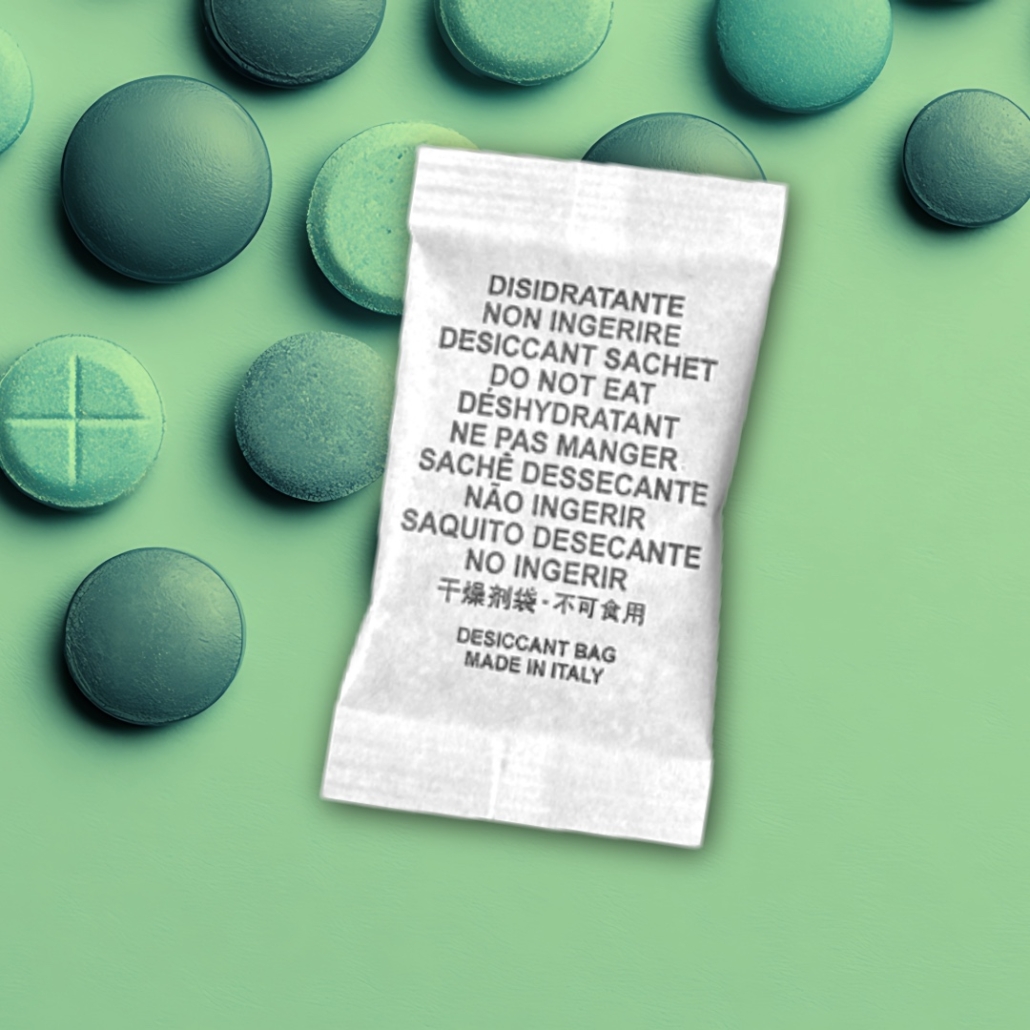
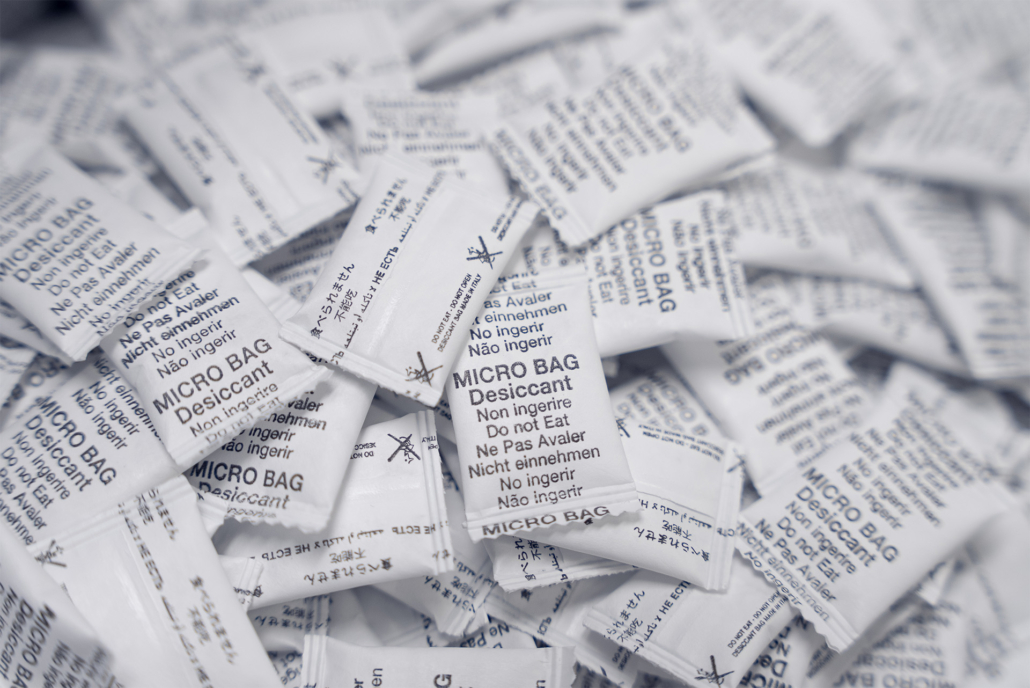
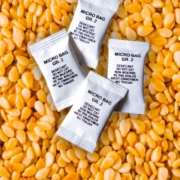
Condensation is prevented with a suitable package and a Micro Bag inside: the desiccant takes up the moisture that enters at each opening before it reaches dew point on the seed. Micro Bag is the right format here because it fits small packets and jars, where a conventional sachet would not.
Why we use Micro Bag for seeds
Micro Bag is the desiccant Levosil produces for direct contact with food and pharmaceutical products. That has a consequence which matters particularly in the seed sector: it is not a vehicle for contamination.
- Manufactured under ISO 15378, the quality standard for pharmaceutical primary packaging.
- Production areas and finished products undergo annual microbiological testing to verify their purity.
- No mould spores are introduced into the container.
The desiccant removes excess moisture from the air and holds the water vapour within itself. It releases nothing, does not alter organoleptic properties and does not act chemically on the seed, which also makes it suitable for organic seed production.
Ocean containers and Levodry Gel
In sea freight the problem changes in kind.
A container crosses different climate zones. The internal air cools, relative humidity rises and reaches dew point, and the moisture condenses: these are the conditions that produce what is known as container rain. According to the Transport Information Service of the German marine insurers, moulds develop from 75% relative humidity upwards and corrosion is negligible below 40%, so relative humidity has to be held below 40% to rule out moisture damage in transit.
The quantities involved are an order of magnitude away from those of a package. The same service calculates that a 20-foot container holding 24 tonnes of cocoa at 12% moisture contains 2,880 kg of water. A study published in 2026 in Heat and Mass Transfer models a fourteen-day winter voyage from Abidjan to Hamburg and predicts 15.4 kg of condensation, 85.8% of it in the final week, with condensation forming even at 6% cargo moisture, well inside microbiologically safe limits.
Levodry Gel does not dry the cargo: it governs the humidity of the air. It is a calcium chloride desiccant that binds water as a gel and does not release it. The hanging strip format can be attached to the container’s lashing rings or fitted into the corrugations of the walls. The number of units per container is calculated from voyage duration, route, season and the hygroscopicity of the cargo. For seeds, which are living and hygroscopic, sizing has to be worked out case by case. Good practice for stowing cargo transport units is set out in the CTU Code, which we covered in a dedicated article.
Key points
- Between 4% and 14%, every percentage point of moisture removed doubles seed longevity; so does every 5 °C drop in temperature.
- Drier is not always better: below 4% there are no documented benefits, and the desiccant quantity should be calculated, not maximised.
- A desiccant only works inside a moisture-barrier package.
- For garden seeds, a jar kept in the refrigerator without a desiccant produces condensation at every opening.
- Micro Bag is manufactured under ISO 15378 for direct food contact, with annual microbiological testing of production areas and products: it introduces no mould spores.
- In sea freight, Levodry Gel governs the humidity of the air and protects moisture-sensitive cargo.
- Levosil calculates the desiccant quantity for your package and the number of units per container: send us volume, material, starting moisture and intended duration.
Contact us: +39 011 96 43 430 — info@levosil.com