Tag Archive for: Container Protection

Desiccants for seeds: every point of moisture doubles shelf life

⏱ Reading time: 6 minutes

Desiccants for seeds keep the seed within the moisture range where it stays viable longest, stabilising its water content and holding it in optimal storage conditions. They apply equally to a commercial seed lot bound for field sowing and to the packets a gardener keeps from one season to the next.

Every percentage point of moisture doubles seed life

The rules of thumb formulated by Harrington (James F. Harrington, 1916-2002, professor emeritus of vegetable crops at the University of California, Davis) and reported by the FAO in its handbook on seed storage are two, and both are precise:

  • between 4% and 14% seed moisture content, longevity doubles for every percentage point of moisture removed. A lot that holds its germination for one year at 12% moisture will hold it for two years at 11%, four years at 10% and eight years at 9%: four points of moisture are worth sixteen times the storage life.
  • between 0 and 50 °C, longevity doubles for every 5 °C drop in temperature.

The working thresholds are equally clear. Above 12-14% moisture, moulds develop. Above 18-20% the lot begins to heat itself through respiration. Below 8-9% insect activity falls off sharply. Between 4% and 8%, storage in a closed container is considered safe.

Getting the dosage right

Drier is not indefinitely better.

Harrington’s rule holds within a defined range, and below 4% there are no documented benefits. The FAO genebank standards call for orthodox seeds (those that tolerate deep drying and low temperatures without losing the ability to germinate) to be dried to equilibrium with an environment at 10-25% relative humidity, and no further. An oversized desiccant in a small, tightly sealed package takes the seed below the level where viability stops improving and, in some species, starts to decline.

The quantity of desiccant has to be calculated from the volume of the package, the water vapour permeability of the material, the starting moisture of the lot, the intended storage period and the adsorption capacity of the desiccant used. The same logic that governs sizing under DIN 55474 for industrial packaging, with one added constraint: the seed is a living organism, and the target is not the absolute minimum but a defined window.

Levosil performs this calculation for the customer, based on the characteristics of the package and the storage conditions declared.

Moisture-barrier packaging

A desiccant works on the air around it. If the package lets water vapour through, the sachet comes into equilibrium with the surrounding environment and saturates, its capacity spent well before the end of the storage period.

This is why the choice of package comes before the choice of desiccant. Paper envelopes, thin polyethylene bags and jars without a proper seal do not hold moisture out: they slow the exchange, they do not stop it. For long-term storage the FAO points to sealed metal containers, thick glass or laminated foil pouches, which hold seed moisture steady for decades.

A moisture-barrier package with the right desiccant inside is a system. Neither one, on its own, is.

Commercial seed lots and warehousing

For a seed company the issue is not storage as such: it is holding the declared germination rate steady from packing through to sowing, including storage in unconditioned warehouses and transport, often by sea.

Levosil desiccants are available in every unit weight, so they can be matched to any type of package.

Garden seeds and home storage

The most common mistake among gardeners is the jar in the refrigerator.

The idea is sound (cold doubles longevity every 5 °C), but moisture has to be controlled as well. Every time the jar is opened, the cold container meets the warm, humid air of the kitchen, and water condenses directly onto the seeds.

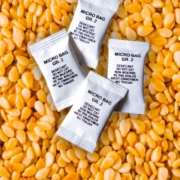
Condensation is prevented with a suitable package and a Micro Bag inside: the desiccant takes up the moisture that enters at each opening before it reaches dew point on the seed. Micro Bag is the right format here because it fits small packets and jars, where a conventional sachet would not.

Why we use Micro Bag for seeds

Micro Bag is the desiccant Levosil produces for direct contact with food and pharmaceutical products. That has a consequence which matters particularly in the seed sector: it is not a vehicle for contamination.

  • Manufactured under ISO 15378, the quality standard for pharmaceutical primary packaging.
  • Production areas and finished products undergo annual microbiological testing to verify their purity.
  • No mould spores are introduced into the container.

The desiccant removes excess moisture from the air and holds the water vapour within itself. It releases nothing, does not alter organoleptic properties and does not act chemically on the seed, which also makes it suitable for organic seed production.

Ocean containers and Levodry Gel

In sea freight the problem changes in kind.

A container crosses different climate zones. The internal air cools, relative humidity rises and reaches dew point, and the moisture condenses: these are the conditions that produce what is known as container rain. According to the Transport Information Service of the German marine insurers, moulds develop from 75% relative humidity upwards and corrosion is negligible below 40%, so relative humidity has to be held below 40% to rule out moisture damage in transit.

The quantities involved are an order of magnitude away from those of a package. The same service calculates that a 20-foot container holding 24 tonnes of cocoa at 12% moisture contains 2,880 kg of water. A study published in 2026 in Heat and Mass Transfer models a fourteen-day winter voyage from Abidjan to Hamburg and predicts 15.4 kg of condensation, 85.8% of it in the final week, with condensation forming even at 6% cargo moisture, well inside microbiologically safe limits.

Levodry Gel does not dry the cargo: it governs the humidity of the air. It is a calcium chloride desiccant that binds water as a gel and does not release it. The hanging strip format can be attached to the container’s lashing rings or fitted into the corrugations of the walls. The number of units per container is calculated from voyage duration, route, season and the hygroscopicity of the cargo. For seeds, which are living and hygroscopic, sizing has to be worked out case by case. Good practice for stowing cargo transport units is set out in the CTU Code, which we covered in a dedicated article.

Key points

  • Between 4% and 14%, every percentage point of moisture removed doubles seed longevity; so does every 5 °C drop in temperature.
  • Drier is not always better: below 4% there are no documented benefits, and the desiccant quantity should be calculated, not maximised.
  • A desiccant only works inside a moisture-barrier package.
  • For garden seeds, a jar kept in the refrigerator without a desiccant produces condensation at every opening.
  • Micro Bag is manufactured under ISO 15378 for direct food contact, with annual microbiological testing of production areas and products: it introduces no mould spores.
  • In sea freight, Levodry Gel governs the humidity of the air and protects moisture-sensitive cargo.
  • Levosil calculates the desiccant quantity for your package and the number of units per container: send us volume, material, starting moisture and intended duration.

Contact us: +39 011 96 43 430 — info@levosil.com
Wood in containers: most of the moisture comes from the cargo, not the air

⏱ Reading time: 9 minutes

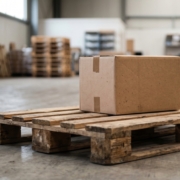
Wood moisture in a shipping container, together with the water held in cardboard and in the goods themselves, is by far the largest source of water on board. The air inside a 20′ container holds less than one kilogram of water vapour, while a single Euro pallet holds several kilograms and can release part of it during the voyage. This is why desiccant bags for containers should be sized on the cargo and its packaging, not only on the volume of air.

The air holds little water

It is often pointed out, correctly, that warm humid air trapped in the container at the port of loading brings water vapour with it. The amount, however, is small: at 30 °C and 90% relative humidity (RH) one cubic metre of air holds about 27 g of water, so the roughly 33 m³ of an empty 20′ container hold about 0.9 kg (about 1.8 kg in a 40′ container). Far more water is held in what is loaded: pallets, crates, cartons and the goods themselves.

Hygroscopic materials and desiccants

A material is hygroscopic when it absorbs and releases water vapour depending on the humidity and temperature of the surrounding air, until it reaches equilibrium (the equilibrium moisture content, meaning the amount of water the material holds steadily at a given temperature and relative humidity). In a closed container it is these materials that set the humidity of the air, not the other way round.

Desiccants are hygroscopic too: the difference lies in how strongly they hold on to the water.

  • Wood, cardboard and natural fibres exchange moisture with the air continuously. When the temperature rises they release it easily, and when the air cools they take it back only slowly, which is why the vapour released in the meantime settles on the coldest surfaces.
  • Desiccants capture moisture even when the air is relatively dry and bind it more strongly. They too can release part of it when the temperature rises, but only at higher temperatures and with more difficulty. In the calcium chloride of Levodry Gel, the water captured forms a solution that remains locked in the gel.

Hygroscopic materials in a container

  • Wood: pallets, crates, cages, dunnage and bracing timber
  • Corrugated board, paper and paperboard
  • Textiles and natural fibres: cotton, wool, jute sacks
  • Leather and hides
  • Agricultural commodities: coffee, cocoa, grain, seeds, tobacco, spices
  • Nylon (polyamide) and some other plastics

How much water the cargo holds

Wood moisture content is expressed as a percentage of the oven-dry mass of the wood: a Euro pallet of about 25 kg at 18% moisture consists of about 21.2 kg of dry wood and 3.8 kg of water. The comparison below is based only on this figure and on the equilibrium values given further on.

Source of waterWater heldWater that can be released
Air in an empty 20′ container (30 °C, 90% RH)about 0.9 kgnot applicable
One Euro pallet, wood at 18%about 3.8 kgabout 1 kg, reaching equilibrium with air at 70% RH (13%)
Eleven Euro pallets (one tier in a 20′ container)about 42 kgabout 11 kg
One pallet made of green (undried) woodover 4.5 kgmost of it, as the wood is far from equilibrium
10 kg of corrugated board (water content 8-14%)up to 1.4 kgabout 0.6 kg, going from 14% to 8%

Figures for green wood and corrugated board come respectively from the Center for Packaging and Unit Load Design at Virginia Tech and from the Transport Information Service (TIS) of the German insurers’ association GDV.

These are theoretical quantities: over a voyage of a few weeks, moisture is exchanged mainly by the surface layer of the wood, so the water actually released depends on the length of the voyage and on temperature swings. The comparison still shows where the excess water in a container comes from: even a single pallet holds more than the air around it.

When wood releases water

The release follows the day and night cycle. During the day the sun heats the steel shell and the air inside, whose relative humidity falls: wood and cardboard, now wetter than the air, give off vapour. At night the ceiling and walls cool first and drop below the dew point (the temperature at which water vapour starts to condense), so the vapour released during the day turns into droplets. Wood reabsorbs moisture from the air only slowly, and the cycle repeats with every temperature swing, particularly when passing between climate zones and during port stays.

Container rain

Condensation forming on the ceiling drips onto the cargo below: this is known as container rain. The droplets wet the top cartons, stain the packaging and create the conditions for mould, even when the container was perfectly dry at departure. The CTU Code, the IMO/ILO/UNECE code of practice for packing cargo transport units, calls for this risk to be taken into account.

Equilibrium moisture content of wood

The table shows the moisture content that wood reaches over time in contact with air at a given temperature and relative humidity. A pallet with a moisture content above the value in the table releases water; one below it absorbs water.

Relative humidity10 °C (50 °F)21 °C (70 °F)32 °C (90 °F)38 °C (100 °F)
90%20.9%20.5%19.8%19.5%
80%16.4%16.0%15.4%15.1%
70%13.4%13.1%12.6%12.3%
60%11.2%11.0%10.5%10.3%
50%9.5%9.2%8.9%8.7%
40%7.9%7.7%7.4%7.2%
30%6.3%6.2%5.9%5.8%
20%4.6%4.5%4.3%4.2%
10%2.6%2.5%2.3%2.3%

Source: Wood Handbook, USDA Forest Products Laboratory, chapter 4, table 4-2. Moisture content on oven-dry basis.

How to read it: a Euro pallet at 18% (about 21.2 kg of dry wood) loaded into a container where the air settles at 70% relative humidity and 21 °C tends to drop towards 13%, releasing about 1 kg of water into the air as vapour. If the air settles at 60% relative humidity, the wood tends towards 11% and the vapour released rises to about 1.5 kg.

What moisture content a Euro pallet should have

The EPAL technical sheet sets dimensions, weight (about 25 kg), materials and heat treatment, but does not specify a moisture content for the wood. The industry reference is the Transport Information Service (TIS) of the German insurers’ association GDV, according to which packaging timber should have a moisture content between 15% and 18%:

  • above 20% moisture and 10 °C, wood becomes susceptible to mould;
  • at 25% moisture, wood has about half the compressive strength it has at 15%, and about two thirds of the bending strength.

For sensitive cargo it is therefore advisable to specify kiln dried (KD) pallets and to check their moisture content with a pin-type moisture meter before loading.

ISPM 15 and moisture

ISPM 15 (International Standard for Phytosanitary Measures No. 15) is the international standard issued under the FAO’s International Plant Protection Convention (IPPC) for solid wood packaging 6 mm thick or more used in international trade. Its purpose is to prevent insects and wood pests from spreading from one country to another. Compliant packaging carries the IPPC mark (the wheat-ear symbol) with the country code, producer code and treatment code, issued under national schemes supervised by each country’s plant protection organisation.

The most common treatment is heat treatment (HT), which brings the wood to at least 56 °C for at least 30 continuous minutes throughout its thickness. ISPM 15 does not deal with moisture: the IPPC explanatory document states that heat treatment may result in little or no moisture reduction, and that heat treated wood may range from green to dry. Kiln drying (KD) is a separate process, designed to reduce moisture, and in turn does not guarantee phytosanitary effectiveness. The same document also notes that heat treatment, by sterilising the wood surface, can promote the growth of surface mould.

The HT mark therefore certifies that the pallet has been treated against pests, not that it is dry: the only way to know its moisture content is to measure it.

Damage caused by excess moisture

  • Mould on pallets, crates, cartons and goods
  • Cartons losing strength and collapsing under the weight of the stack
  • Labels peeling off or becoming illegible
  • Corrosion of metal parts, machinery and components
  • Stains, water marks and warping of wood and packaging
  • Caking of powders and granular products (fertilisers, salt, sugar)
  • Deterioration of agricultural commodities such as coffee, cocoa and grain
  • Musty odours that make goods unsaleable

Protecting the cargo

Since most of the water comes from the cargo, protection starts before departure: pallets and crates made of dried wood, cartons stored in a dry environment, hygroscopic goods at the correct moisture content. Container desiccants complete the system by capturing the vapour the cargo releases during the voyage, so that the dew point of the air stays below the temperature of the walls even through temperature swings.

Levodry Gel and UFI code

Levodry Gel is a calcium chloride container desiccant. As a mixture classified under the CLP Regulation (Regulation (EC) No 1272/2008), it falls under the UFI requirement (Unique Formula Identifier), a 16-character alphanumeric code that links the product label unambiguously to the information on its composition. The requirement stems from Regulation (EU) 2017/542, incorporated into Annex VIII of the CLP Regulation, and has applied to all hazardous mixtures since 1 January 2025.

The code is used by poison centres: in the event of accidental exposure, it allows them to identify the composition of the mixture quickly and respond appropriately. Notifications are submitted through the ECHA portal and received by the appointed body in each Member State (in Italy, the Istituto Superiore di Sanità).

Levodry Gel has been notified through the ECHA PCN portal and to the ISS, and its labels carry the registered UFI code, available on request for customers’ compliance checks.

Key points

  • The air in an empty 20′ container holds about 0.9 kg of water at 30 °C and 90% RH; a single Euro pallet at 18% moisture holds about 3.8 kg.
  • Wood, cardboard and natural fibres are hygroscopic: they release vapour when the temperature rises and take it back slowly.
  • Desiccants can also release part of their moisture, but only at higher temperatures and with more difficulty.
  • Vapour released during the day condenses on the ceiling at night and drips onto the cargo (container rain).
  • Packaging timber should have a moisture content of 15-18%: above 20% the risk of mould increases.
  • The ISPM 15 (HT) mark certifies treatment against pests, not the moisture content of the wood.
  • Further reading: container protection.

Contact us: +39 011 96 43 430 — info@levosil.com
UFI mandatory on labels: Levodry Gel is already compliant

What the UFI is and what it does

The UFI (Unique Formula Identifier) is a unique alphanumeric code, made up of 16 characters, that must be printed on the product and on its label. Its purpose relates to health and safety: it unequivocally links information on the composition of a mixture to a specific product placed on the market. In the event of accidental exposure, it allows poison centres to quickly retrieve information on the composition and toxicology of the mixture by consulting the European database that associates each UFI code with the information notified through ECHA.

Who keeps the UFI database?

The UFI does not exist on its own: it is linked to a PCN notification (Poison Centre Notification). ECHA provides a centralised portal (the ECHA submission portal) for notification to poison centres. In Italy, the Istituto Superiore di Sanità (ISS) is the body designated to receive the information — including the chemical composition — relating to mixtures classified as hazardous. This information makes up the Archive of Hazardous Preparations (Archivio dei Preparati Pericolosi, APP), which poison centres can consult in an emergency.

The UFI refers to a single product and is “personal”

Every UFI code is personal and non-transferable: because it is built from the VAT number of the company placing the product on the market and from a specific formulation number, it unequivocally links a given mixture to the party responsible for it. Products with a different composition have different UFIs, and every change in the formula corresponds to a new code. It should be stressed, however, that the code cannot be used to trace the composition of the mixture or any other confidential data: the UFI is not decodable, and the information associated with it is held in a database accessible exclusively to poison centres and healthcare facilities, in the event of an emergency. For this reason, its presence on the label in no way exposes resellers or those who market the product; it represents solely a guarantee of safety and compliance.

Reference legislation and obligations for those placing the product on the market

The UFI originates from Regulation (EU) 542/2017, which was incorporated into Annex VIII of the CLP Regulation 1272/2008. It is not an option but a legal obligation: companies that place hazardous mixtures on the market must transmit the necessary information to the competent national bodies, so that poison centres can rapidly provide medical advice in an emergency. The parties subject to the obligation are importers and downstream users who, in the course of industrial and professional activities, place on the market mixtures that are hazardous to health and/or present physical hazards. Failure to comply with the obligation may result in products being withdrawn from the market and in financial penalties, with possible inspections by the competent authorities.

Since when it has been mandatory to display it on the product

The final deadline has now passed: since 1 January 2025, the UFI on the label has been mandatory for all hazardous mixtures marketed within the European Economic Area, without exception. The obligation also applies to mixtures already placed on the market before that date.

The case of calcium chloride desiccants

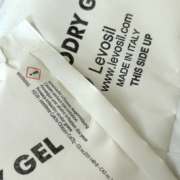
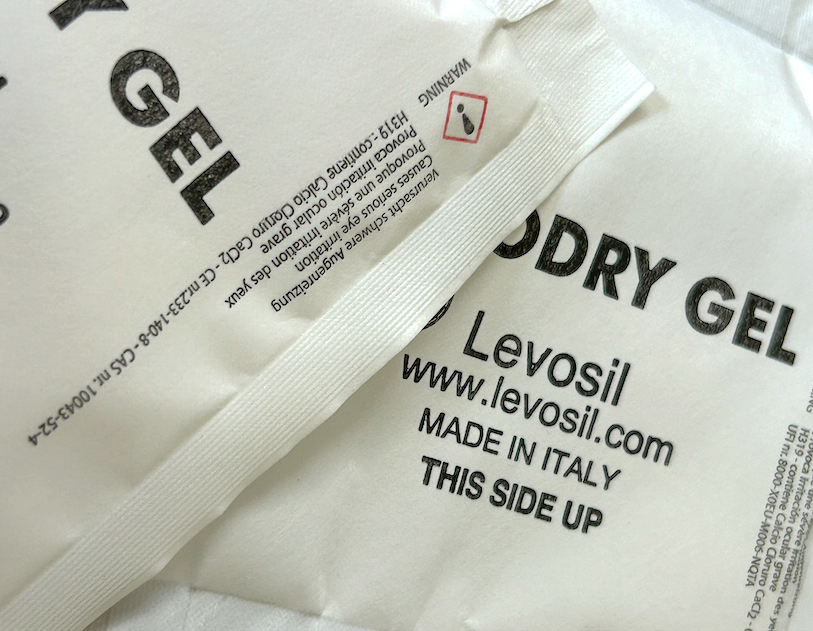
The classification of calcium chloride — the main component of all desiccants used to protect containers, Levodry Gel included — is the reason why the irritant symbol and the information required by law are printed on the label and on the product itself. Under normal conditions of use, no contact is expected between the person using the desiccant bag and the calcium chloride contained inside it; this does not, however, relieve the manufacturer and the party placing the product on the market of the obligation to indicate the presence of a potentially irritant substance inside the packaging.

Desiccant bags based on calcium chloride, such as Levodry Gel — which contains between 60% and 90% of it — are classified as irritant (eye irritation category 2, H319 – “Causes serious eye irritation”) under the CLP Regulation. They therefore fall fully within the scope of the mixtures subject to the obligation. For this reason they must be notified through ECHA’s PCN portal and, for Italy, registered with the Istituto Superiore di Sanità (ISS). Only after this registration is the UFI code generated, validated and affixed to the product. Once these formalities have been completed, the product can be placed on the market.

It is important to note that a product requiring any hazard classification cannot be placed on the market unless the UFI code has been registered.

Product safety

It is essential to understand that, in the case of Levodry Gel, the calcium chloride is contained within a functional barrier, and therefore in normal working operations the user is not expected to come into direct contact with the calcium chloride. Nevertheless, the law requires that the product be labelled and that the UFI code be registered with the competent authority as a precaution, in case of improper use or of leakage of the calcium chloride should the outer casing break.

Where the code must appear: label and product

The UFI must be physically present on the product and on its label, printed or affixed in a visible, legible and indelible manner, preceded by the letters “UFI”, which are not to be translated into the various languages.

Levosil has already done everything

Levodry Gel has its own code duly stated in the Safety Data Sheet and affixed to the product label, in full compliance with the CLP Regulation and its Annex VIII. Notification to the poison centres has been carried out, and the emergency contact details are indicated in every language version of the sheet. Choosing Levosil means purchasing products that are already compliant, with no risk of non-conformity for those who resell them or place them on the European market in turn.