UFI mandatory on labels: Levodry Gel is already compliant
What the UFI is and what it does
The UFI (Unique Formula Identifier) is a unique alphanumeric code, made up of 16 characters, that must be printed on the product and on its label. Its purpose relates to health and safety: it unequivocally links information on the composition of a mixture to a specific product placed on the market. In the event of accidental exposure, it allows poison centres to quickly retrieve information on the composition and toxicology of the mixture by consulting the European database that associates each UFI code with the information notified through ECHA.
Who keeps the UFI database?
The UFI does not exist on its own: it is linked to a PCN notification (Poison Centre Notification). ECHA provides a centralised portal (the ECHA submission portal) for notification to poison centres. In Italy, the Istituto Superiore di Sanità (ISS) is the body designated to receive the information — including the chemical composition — relating to mixtures classified as hazardous. This information makes up the Archive of Hazardous Preparations (Archivio dei Preparati Pericolosi, APP), which poison centres can consult in an emergency.
The UFI refers to a single product and is “personal”
Every UFI code is personal and non-transferable: because it is built from the VAT number of the company placing the product on the market and from a specific formulation number, it unequivocally links a given mixture to the party responsible for it. Products with a different composition have different UFIs, and every change in the formula corresponds to a new code. It should be stressed, however, that the code cannot be used to trace the composition of the mixture or any other confidential data: the UFI is not decodable, and the information associated with it is held in a database accessible exclusively to poison centres and healthcare facilities, in the event of an emergency. For this reason, its presence on the label in no way exposes resellers or those who market the product; it represents solely a guarantee of safety and compliance.
Reference legislation and obligations for those placing the product on the market
The UFI originates from Regulation (EU) 542/2017, which was incorporated into Annex VIII of the CLP Regulation 1272/2008. It is not an option but a legal obligation: companies that place hazardous mixtures on the market must transmit the necessary information to the competent national bodies, so that poison centres can rapidly provide medical advice in an emergency. The parties subject to the obligation are importers and downstream users who, in the course of industrial and professional activities, place on the market mixtures that are hazardous to health and/or present physical hazards. Failure to comply with the obligation may result in products being withdrawn from the market and in financial penalties, with possible inspections by the competent authorities.
Since when it has been mandatory to display it on the product
The final deadline has now passed: since 1 January 2025, the UFI on the label has been mandatory for all hazardous mixtures marketed within the European Economic Area, without exception. The obligation also applies to mixtures already placed on the market before that date.
The case of calcium chloride desiccants
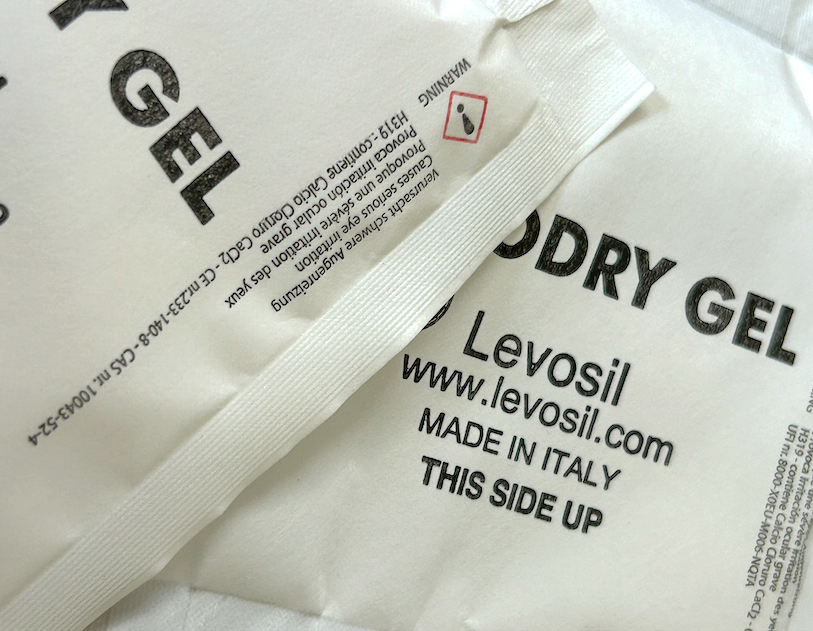
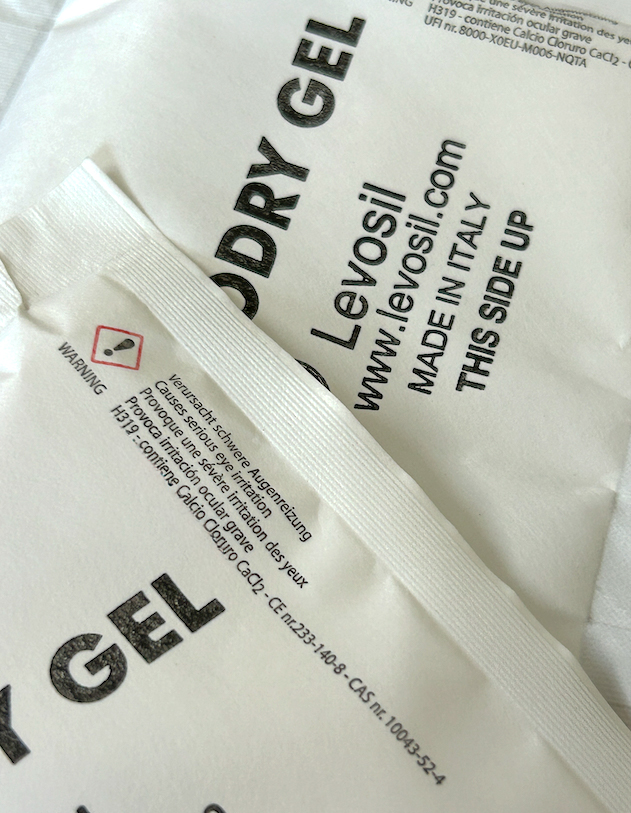
The classification of calcium chloride — the main component of all desiccants used to protect containers, Levodry Gel included — is the reason why the irritant symbol and the information required by law are printed on the label and on the product itself. Under normal conditions of use, no contact is expected between the person using the desiccant bag and the calcium chloride contained inside it; this does not, however, relieve the manufacturer and the party placing the product on the market of the obligation to indicate the presence of a potentially irritant substance inside the packaging.
Desiccant bags based on calcium chloride, such as Levodry Gel — which contains between 60% and 90% of it — are classified as irritant (eye irritation category 2, H319 – “Causes serious eye irritation”) under the CLP Regulation. They therefore fall fully within the scope of the mixtures subject to the obligation. For this reason they must be notified through ECHA’s PCN portal and, for Italy, registered with the Istituto Superiore di Sanità (ISS). Only after this registration is the UFI code generated, validated and affixed to the product. Once these formalities have been completed, the product can be placed on the market.
It is important to note that a product requiring any hazard classification cannot be placed on the market unless the UFI code has been registered.
Product safety
It is essential to understand that, in the case of Levodry Gel, the calcium chloride is contained within a functional barrier, and therefore in normal working operations the user is not expected to come into direct contact with the calcium chloride. Nevertheless, the law requires that the product be labelled and that the UFI code be registered with the competent authority as a precaution, in case of improper use or of leakage of the calcium chloride should the outer casing break.
Where the code must appear: label and product
The UFI must be physically present on the product and on its label, printed or affixed in a visible, legible and indelible manner, preceded by the letters “UFI”, which are not to be translated into the various languages.
Levosil has already done everything
Levodry Gel has its own code duly stated in the Safety Data Sheet and affixed to the product label, in full compliance with the CLP Regulation and its Annex VIII. Notification to the poison centres has been carried out, and the emergency contact details are indicated in every language version of the sheet. Choosing Levosil means purchasing products that are already compliant, with no risk of non-conformity for those who resell them or place them on the European market in turn.