How long can desiccant bags stay exposed to air?
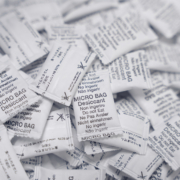
This is one of the questions we are asked most often: how long can a desiccant bag remain exposed to air before being used?
The basic rule is simple: as little as possible. As soon as they are removed from their packaging, desiccant bags immediately begin absorbing moisture from the surrounding environment.
Why there is no fixed time
It is not possible to determine in advance how quickly a bag will become saturated, because its absorption capacity depends on several variable factors:
- the relative humidity of the environment;
- the temperature it is exposed to.
A concrete example: in winter, when the air is drier, the bags saturate more slowly. In summer, especially on a rainy, humid day, the same bag can saturate much faster. This is why there is no universally valid figure.
The role of the envelope (fabric)
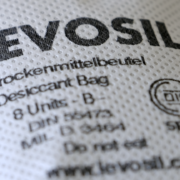
Beyond ambient conditions, the speed at which a bag saturates is mainly governed by the type of envelope wrapping it. A standard fabric envelope (under DIN 55473 this corresponds to Type A) lets water vapour through more quickly, so it saturates sooner. A Type B (low dust) or Tyvek® bag will take longer to saturate.
Important: molecular sieves are a special case
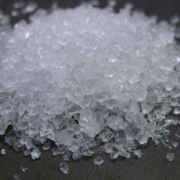
This rule does not apply to molecular sieve desiccant bags. Molecular sieve is an extremely moisture-hungry desiccant and absorbs water vapour from the environment very rapidly. In these cases it is essential to keep exposure times very short or to work in a controlled environment.
How to store them correctly
If the bags are not used immediately, follow a few precautions:
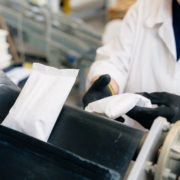
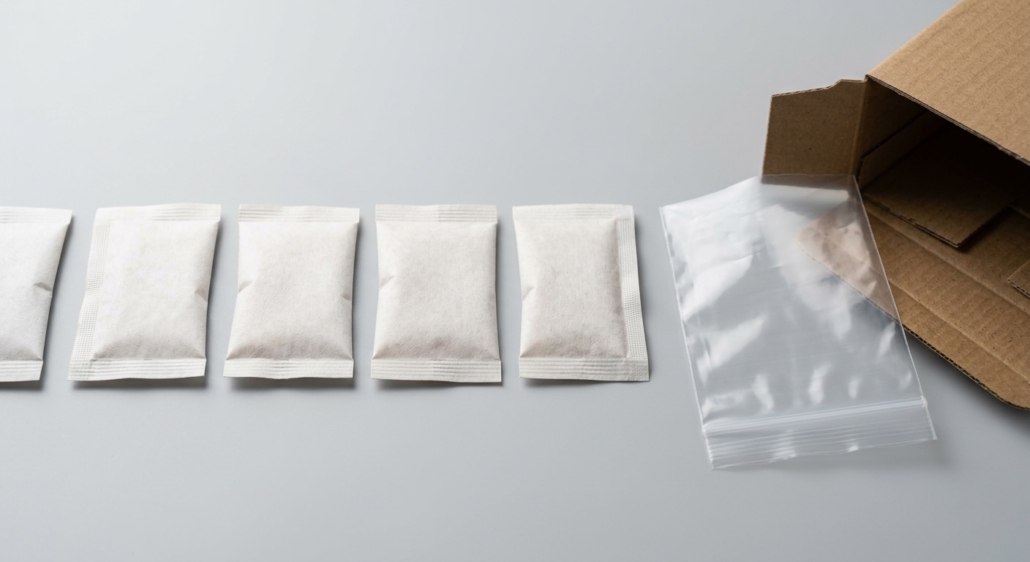
- keep them in their original packaging, with the plastic bag we supply folded over the top;
- when the product is returned to the warehouse, the ideal solution is to heat-seal the HDPE bag protecting the desiccants inside the box;
- alternatively, close the bag with a cable tie or a knot.
This prevents ambient moisture from saturating the bags during storage and periods of non-use, before they are even put to work.
The principle to remember is always the same: the less time exposed to air, the more effective the product.